Dies des del Referèndum de l'u d'octubre de 2017

Fes una piulada

Cercar en aquest blog

StatCounter

Es mostren els missatges amb l'etiqueta de comentaris Franco. Mostrar tots els missatges

12/31/2020

Commons debate in May 1961 on UK position vis-a-vis the Franco regime

At the end of May 1961 the UK Opposition criticized the Home Secretary for his remarks, made in Madrid, on the Spanish government and regime.

Click  to read the whole post, if need be

2/11/2020

The Spanish question, House of Commons (31 JAN 1939)

The Spanish issue, and relations with Germany and Italy, were debated in the House of Commons on 31 January 1939.
Click here if need be to read the whole post 

1/28/2016

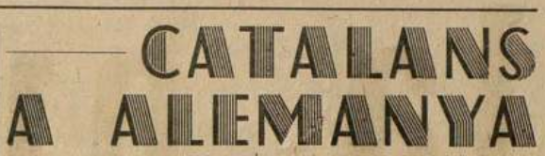
Catalans in Germany

The original text of this article was posted by ANC Llengua2. This text in English is here. Thanks, Georgina!


On 26 January 1939, seventy-seven years ago, Franco’s troops took Barcelona and, on the following day, Badalona, ​​Santa Coloma de Gramenet, El Masnou, Premià de Mar, Vilassar de Mar, Mataró, Artés, La Llagosta and Sant Fost de Campsentelles.

All those who went into exile had to cope with an exodus that led them to both hunger and uncertainty (such as the one that Europe is contemplating, allowing and fueling again), and led many to their deaths or a new war, or to deportation to the Nazi extermination camps.

Some returned – too few, and condemned to silence and disbelief, deaf ears and neglect, shame and trauma.

Some fanned the flame and the resistance, the responsibility of freedom and memory, some words, some pictures.

An example of this is La Humanitat, the ERC’s weekly, published in Paris (according to memoriaesquerra.cat, the Fundació Josep Irla website) from 1944 to 1953 (“internal newsletter of Esquerra Republicana de Catalunya, member of Solidaritat Catalana”).

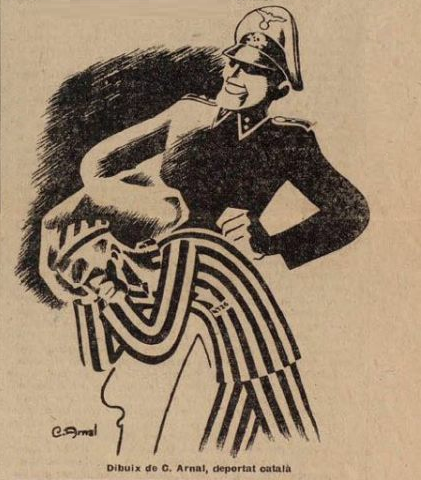
On page 2 of the September 23, 1945 issue, No. 24, a column, and a drawing by C. Arnal, relate the return of the deportees from Germany.

Catalans a Alemanya - Catalans in Germany

If only we all knew with what emotions of excitement, hope, frustration or sadness (and perhaps resentment) this publication was received at the time, printed on a single sheet and four pages, and dated 23rd September 1945!

To see all those names, mentioned one by one (and particularly Joaquim Amat Piniella, whose name has been revived in recent years thanks to the reedition of his book K. L. Reich). How these lists help to keep the struggles and the suffering alive in our minds!

In their honour and memory, we have decided to transcribe the full text, as a historical record, above and beyond one particular political party. These events are part of all of us.

"Catalans in Germany


La Humanitat, No. 24, September 23 1945, page 3, “Catalans in Germany”.
 
"Some days ago, we rejoiced over the return of deported Catalans from Germany. We did so with joy, moved by the fact that our words were addressed to the best of our fighters, who never lost their faith in Catalonia and in freedom. We did so also thinking that many members of our Party would return amongst us. And so it has been. Every day we receive news of those who have returned. Old acquaintances are renewed with delight. The same delight with which we often hear from people themselves or from their departmental organizations. They have all passed the ordeal that was reserved for deportees, they have all suffered and it will take time for them to recover. But they all tell us that they have not stopped believing in Catalonia and our ideals.

"Shortly after returning many, such as Marian Abella, who now chairs the Loire Departmental Committee, have resumed their activities among our ranks. A few days after his return Lluís Fages, a member in Catalonia of “El Foment de Reus”, wrote to us from Annecy to tell us that “I think I have to get in touch at once with the Party”. We have received similar news from our friend Antoni Bofarull Ferrer, secretary of the Baix Camp district party delegation in Tarragona, from Josep Pérez Fontcuberta, Lluís Jordà i Perich, Lluís Planes, Francesc Maya, J. Amat Piniella… and of course from the Eastern Pyrenees, where one of the most important delegations of our Party has informed us of the return of Francesc Vivé-Sánchez, Pere Lladó i Bret, Joan Huc i Vallespí, Jaume Huc i Peco, Jaume Garriga Coll, Pere Ferrero and Juli Ferrero.

"Unfortunately our joy cannot be complete - far from it. Many of our colleagues will never come back from Germany. There are some about whom we have no news at all. We have received specific news of others who died there. In Dachau, Ramon Serra (a party member from District V in Barcelona), the Vergès brothers from Reus, and our colleagues Coderch and Riera from Badalona, have all died. In Buchenwald, Josep Serra i Mistral and Antoni Canut i Morich of the ERC’s Ateneu Obrer in District V [Barcelona], and Antoni Gomis (party member from District IV) have all died. Lluís Ametllet i Roig, from the Girona Federation, and Francesc Abelló from Granollers have also died. We remember today these beloved companions as well as all the Catalans who have died in Germany, their only sin having been to love and serve their people and Freedom.

"From these lines we are duty-bound to point out the Catalan contribution to the crusade that has just ended with the defeat of international fascism and we once again underline the shocking mockery aimed at all those who have suffered and died in Germany: they cannot yet return to their homeland, which is still run by a system that has been defeated on battlefields across the world."

Catalans in Germany Alemanya, drawing by C. Arnal, Catalan deportee

Catalans in Germany, drawing by Josep Cabrero i Arnal, Catalan deportee.
La Humanitat, No. 24, September 23 1945.
Translated by Miquel Strubell and proofread by Georgina Bryan-Brown.

3/05/2012

More than their fair share

[N'hi ha una traducció al català, feta per mi, a la revista TRIBUNAhttp://www.tribuna.cat/opinio/politica/mes-del-que-els-pertoca-05-03-2012.html, amb el títol "Més del que els pertoca". L'original el reprodueixo amb permís de l'autor, que ha demanat restar en l'anonimat]


Over the centuries since Catalonia lost its independence, Catalans have been on the receiving end more than most. Is that what 'belonging' to Spain amounts to?

For over 350 years the troops of the kingdom of Castile have bombarded, besieged and ravaged Catalonia's cities. French armies, in the name of their King and then for the Republic, have annexed large tracts of their land north of the Pyrenees, and have burnt down, among many other monuments, one of the greatest libraries in Europe. The armies of rival Spanish dynastic pretenders have wreaked havoc in our towns and villages. Germans, for their Fuhrer, and Italians, for their Duce, have tried out their military developments and weapons on civilian urban targets. 
 An unholy alliance of Spanish monarchists, fascists and army officers, - with the help of Moorish troops and the support of Catholic Church leaders- have fought for control with defenders of a Republican model of Spain, while the Soviets waged their own war in the streets of Barcelona-, driving thousands of Catalans, including their political, social and scientific elites, into exile over the mountains to avoid still-unpunished bloodbaths and acrid vengeance. 

For some, the miracle is that despite all this, the Catalans still exist as a vibrant people, with a living language, a creative culture and an unflagging will to look to the future.

What a rapidly growing number doesn't understand, however, is why Catalonia is not, like most other European nations, a free country in its own right.

All the more so when in the past year every single opinion poll has shown that those saying they would vote for independence in a referendum outnumber those that say they would vote against, in several recent cases by around twenty percentage points.

The Catalans' resilience is in part due to their traditional posture in the face of - always - far more powerful forces than their own. Theirs is a culture of passive, 'back-office' defiance rather than face-to-face assertiveness. Each time Catalan has been banned in schools, clandestine groups have gathered to share literacy classes, to read literature, to hold secrete poetry competitions. When Catalan (or Valencian, or Majorcan) singers' lyrics have been politically censored they have found  subtle euphemisms to talk about dictatorships and the lack of freedom ('the aging mountain', 'the post'...), or have been forced to earn their living abroad. When publishers were forbidden to print works in Catalan other than those of classical authors (and in archaic spelling), they tricked the system in various ways; one printed the work of a (living!) Classics teacher.

All this, it may be said, belongs to the past. But Catalonia still belongs to Spain, whose elites have for centuries shared a national project in which Catalonia as a differentiated people with a language, a culture, a history, and institutions going back even more centuries has had no place.

It is the past that explains this present European anomaly.

And it is the present that explains why the largest demonstration in the recent history of the continent took place in Barcelona, on July 10 2010, after what many regard as the ultimate attempt, by the main Spanish parties and the Constitutional Court, to humiliate the Catalans and cut back their claims to (greater) autonomy. And why hundreds of grass-root organisations across the country have since held local referenda - with no official sponsorship or public funding whatsoever, but exquisitely organised - on Catalonia's independence. And why the last of them, held on April 10th last year in Barcelona, almost doubled the turnout of a previous popular consultation (on a different issue) organised by the City Council with the backing of a massive budget.

Yet despite the title of this article, the press is full of the opposite message: that Catalonia feels it is getting less than its fair share. And this is also true, and is helping to fuel the flames. Catalonia's economy is being choked by the lack of central government investment. Official statistics show that in 2005 (the last time the figure has been calculated) fiscal spoliation amounted to almost 9% of Catalonia's GDP. Longterm milking of the Catalan economy is exacting a crippling toll, as Catalan firms pay the price in terms of lost competitiveness. What used to be Spain's power-house is scarcely allowed to have intercontinental flights (when, for that matter, did anyone last see an Iberia plane at a Catalan airport?). Work on essential European-gauge railway infrastructures needed to allow the port of Barcelona (and Tarragona... and Valencia and Alicante) to act as the natural nodes of Europe's trade with the Middle and Far Eastern markets is being held up by the Spanish government, which keeps hinting it would prefer to bore a pharaonic tunnel through the Central Pyrenees, even though the French seem unwilling to take on their (monumental) share of the project on the other side.

It can be argued that it is fitting that richer regions pay more and poorer regions receive more. True and reasonable. But not to such a degree (more than twice the upper limit allowed in Federal Germany, for instance), not if this means Catalonia is actually being overtaken by less wealthy regions. And not if two wealthy regions do not pay such contributions at all (and whose inter-regional fiscal deficit as a result is under 3%!).

It is in this context that thousands of Catalan citizens (by no means all Catalan-born and bred; all segments of society are suffering in the crisis because of Catalonia's current status as a region of Spain with very limited powers to overcome) are joining the Assemblea Nacional Catalana (http://www.assemblea.cat) which will hold its first General Assembly on March 10th. This grass-roots organisation already has over 200 local assemblies across the country and aims by democratic means to consolidate the social majority in favour of independence, and to put pressure on the political parties a majority of whose voters support this noble objective to include (in some cases, for the first time) their commitment to independence through a referendum or a plebiscite in their 2014 election manifesto.

Noone hides the gravity of the challenges ahead. On the international front, the precedents are there for all to see. Ruthless Spanish diplomatic pressure on national sports federations around the world, to prevent Catalan federations joining their international sports federations is a good example (a notorious case in point being the International Roller Sports Federation, of which Scotland is a member). It is hard to believe that fully twenty Catalan federations are indeed recognised! Nor are some other countries sympathetic: French courts have blocked the Catalan Rugby Federation, a founder-member of the International Amateur Rugby Federation in 1934, and its attempts to reverse its expulsion in 1941, when the Pétain and the Franco régimes were in power.

Yet the Catalans are learning the virtues of being ambitious. How else could they have achieved a unique internet top-level domain for .CAT, covering the whole Catalan(-speaking) community?

March 10 may prove to be a crucial stepping-stone in the Catalans' steadfast march along the Road Map towards what, after all, is no less (and no more) than what most European peoples have achieved, though often at the expense of tragically shedding blood. It is my heartfelt hope that Europe will endorse, and indeed encourage, the use of democratic means to allow the Catalans to forge their own place in the world and make their contribution to a more just, sustainable and prosperous planet.

2/08/2010

A message from the "Comissió de la Dignitat"

I received this in my email today.


Dear friends,

I think every worthy cause deserves a day like today. A day in which the transparency of the air enables you to see the very last wrinkle of your opponent's sullied face. And this is what today's newpapers have brought us. Firstly, the news that judge Baltasar Garzón is to be tried and possibly suspended from his job at the Audiencia Nacional Court (a Special court which, admittedly, should not even exist) for having dared to open up the possibility of investigating the sombre truth about Franco: the mass graves and other crimes perpetrated by his regime, not least of which the mass graves with 26,300 bodies discovered in Valencia in 2005. But that is not all. The newspapers also inform us that the huge monument honouring the Cruiser Baleares in Palma bay -the pride of Franco's fleet sunk by the Republicans after having shelled thousands of fleeing refugees on the coastal roads of Andalusia- is not to be demolished. It is to be conserved! What an example for today's youth, to be sure! Can you image the same occurring with a monument dedicated to a Fascist-manned warship in any other part of the democratic world? This could only happen in Spain. But there is yet more. Today the Basque Parliament (where PP, PSOE and Rosa Diez's clique have the majority allowed them by the suppression of the Basque left) have voted against instating a Truth Commission (such as the ones established by Nelson Mandela in South Africa in the early nineties) to discover the truth about the crimes of Franco. This must not be unearthed!

Today has therefore been a good day for the Catalan cause, and the cause of democracy, which are indeed part and parcel. From today on we may go to democrats the world over and point to Spain's huge democratic deficit without fear that anyone with eyes in their head might fail to perceive it.

Europe largely ridded itself of Fascism in 1945. The one place it lives on is in putrid old Spain, where 56 of the streets in Madrid still bear the names of Franco's generals. As Euronews said today, who can be surprised that Catalans want to be free of all this?

Dear friends. I'm writing all this in English because I feel the sooner the whole world knows, the sooner we can put an end to so much iniquity and disgrace.

Democracy and Dignity. Barcelona February 5th 2010
Baròmetre de l'ús del català a Internet